Bologna’s Santa Maria della Vita: how does terracotta make emotion visible?

At Santa Maria della Vita, the drama of sculpture can arrive before you have read a label. Niccolò dell’Arca’s Compianto sul Cristo morto gathers life-size figures around the dead Christ, with sharply different responses to grief. The work does not require an immediate verbal explanation from you. Give yourself a quiet moment to register it, then use looking as a way to understand how that response has been produced.
Begin with differences between the figures
The operator’s account describes a fifteenth-century terracotta group, originally coloured, commissioned by the confraternity associated with the complex. It places the work within a broad date range rather than one uncontested year. Keep that breadth in mind. A visitor can understand the emotional relationships without pretending that every historical question about the commission has been settled.
Choose two figures and compare their gestures. One may appear to move outward while another seems to draw inward; a hand can confront what a face seems unable to bear. These are observations to test against the accompanying interpretation, not a substitute for identifying the figures correctly. Read the labels after your first look, then look again. The second encounter often reveals a quieter detail that the initial drama concealed.
Let the empty spaces participate
Sculpture occupies a room with you. Notice the intervals between figures and how those intervals change the apparent direction of a gesture. You do not need to walk around a restricted area to appreciate this; use only the permitted route. A photograph can flatten a hand against a body or merge separate forms, whereas a modest shift in your own position may make their relationship clearer.
Avoid turning this into a search for the most sensational expression. Grief is also communicated through restraint, stillness and the contrast between figures. For visitors with children, start with a simple explanation that the scene concerns mourning, and allow anyone unsettled by it to step back. There is no obligation to react in the same way as a companion, or to perform a strong emotion because the work is famous.
Remember the material
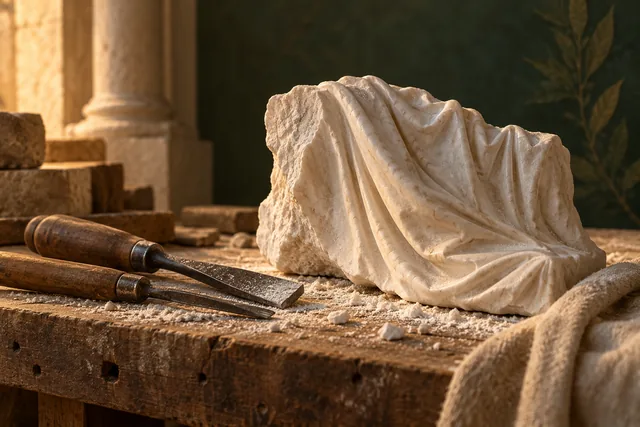
The figures are terracotta, not carved marble. That basic fact changes the questions you can ask about their making. Look for the visual effect of folds and surfaces without reaching towards them. Modelling, firing, colouring and later conservation belong to different stages of an object’s history; a quick glance cannot tell you everything about those stages. The current reddish appearance should not be treated as proof that the group always looked exactly as it does now.
Our San Domenico guide offers another sculptural encounter with a different history of authorship. The San Francesco article adds a comparison in the relationship between monuments and their setting. Use these connections to sharpen attention to material and purpose, rather than placing every sculpture on a single scale of beauty or importance.
Do not merge the church and oratory works
The complex also includes an oratory containing Alfonso Lombardi’s Transito della Vergine. It is a separate sculptural group by another artist, not another name for Niccolò’s Lamentation. Check the current route and ticket conditions if you want to see both. The metropolitan cultural service identifies the church, oratory and care-related history of the complex, while the operator supplies the current visiting arrangements.
That wider context matters. Santa Maria della Vita developed around religious life and assistance to people in need, not simply around a modern museum itinerary. The works’ present display is one stage of that history. Our slow walk towards Santo Stefano can help keep the visit within a manageable central route, leaving room to pause instead of treating the next church as another item to complete.
Plan enough time for a second look
As checked on 24 October 2026, the operator publishes current hours, ticket categories and booking conditions on its own page. Prefer those over older third-party schedules, and contact the venue to reserve an independently organised group. Its information describes a downloadable audioguide; bring your own headphones if you intend to use it. Check any access needs in advance and follow the route and photography instructions given on arrival.
Compare our Bologna arts and culture experiences by their stated inclusions. For a later visit in Florence, Florence Tour Hub’s Museo Horne article offers a quieter contrast in how objects are arranged for looking. Here, the practical goal can be small: understand one gesture better on the way out than you did on the way in. That is enough to turn a powerful first impression into a thoughtful visit.
Sources & further reading
Turn a good read into a great day.
Find a highly rated Bolognese experience that brings these stories to life.
Explore related experiences →