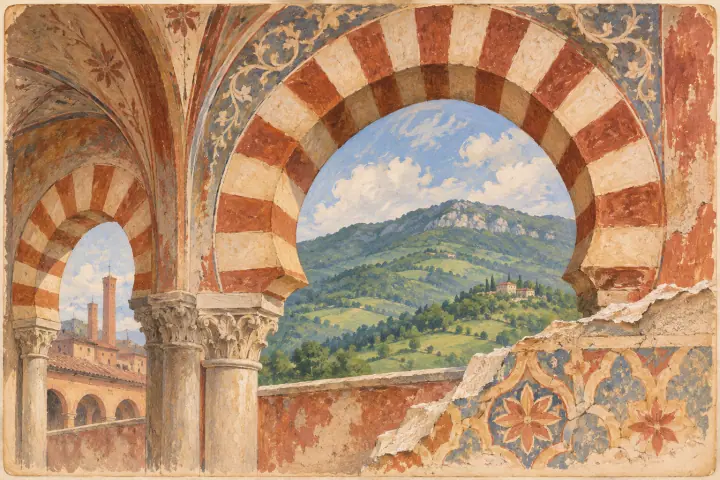
A window in the painting on a walk through Dozza

A painted figure on a wall in Dozza has a neighbor a canvas in a gallery rarely has: a real window that somebody may open tomorrow morning. In this hill town near Bologna, contemporary artworks occupy the outer walls of houses and shops. A doorway can interrupt a composition, a shutter can repeat one of its colors and the person looking at it is likely to be standing in a working street. Choose one wall and look at it as a painting made for a particular address. The whole village becomes more interesting as a result.
What the Biennale left in the streets
The Comune di Dozza’s account of the Muro Dipinto traces the project to an idea by Tomaso Seragnoli in the 1960s. Artists invited through successive editions made paintings and reliefs for the town. The national cultural register dates the first event to 1960 and the change to a biennial format to 1965. That helps explain why it is possible to visit a collection called the Painted Wall Biennale on a day when no festival is in progress. Works made during past editions remain part of the streets.
A live edition and an independent walk offer different kinds of evidence. During an event one may see decisions being made and surfaces being prepared, depending on the programme. On an ordinary day the finished work has acquired neighbors, shadows and seasonal changes in light. If you are traveling to see an artist work, check the organizer’s current event details. If you want to look at the public walls, the municipality describes them as accessible without opening hours or an admission ticket.
Begin with something the artist could not move
Choose an actual door, drainpipe, balcony or set of shutters near a painted area. Look at the lines of the image as they approach it. Does a color stop a little short, continue around a corner or make the architectural feature seem to belong to the scene? Then imagine transferring the same drawing to a blank rectangle in a gallery. If it would lose a joke, a reference or an entire edge of its composition, the street has done part of the artistic work.
Step back far enough to include the pavement and the story above, provided doing so keeps the route clear. A narrow street can make it impossible to see a large mural straight on. Approaching from one direction may reveal the subject gradually, while coming from the other delivers it all at once. A photograph cropped tightly to the painted part conceals these differences. For a comparison in Bologna, our Palazzo Fava guide asks how an image changes when it has to carry a story around an architectural space.
Some paintings have an indoor second life
The Ministry of Culture’s account of the Biennale and its gallery describes preparatory drawings preserved in the Rocca and several murals detached because they faced a serious risk of damage. A sketch offers a record of intention before a design meets an uneven wall. A detached painting preserves some original material but changes the distance, light and architectural interruptions through which visitors read it. A work that has moved inside therefore offers a different answer to the question of what should be conserved.
If you want to visit the Rocca as well, check the current gallery route and hours independently of the free street collection. Holding a drawing in an archive does not mean every sketch is on display at once. The organizing foundation’s visitor contacts give the address at the Rocca and a way to confirm current plans. For a shorter visit, make one drawing of a window and its surrounding painting in your own notebook. Include the sill and any shadow it casts.
Remember that these are also front doors
The freedom of an outdoor collection depends on people being able to go on living and working around it. Step aside for residents, deliveries and passing traffic. Look at the visible work from public space and leave private doorways and stairs to their occupants. When photographing a painting built around a window, frame the exterior surface and avoid photographing into someone’s rooms. These ordinary courtesies also sharpen the difference between the art and the life beside it.
Plan both legs of the trip to the historic village of Dozza, particularly if using public transport. A nearby main road or station is not the same as arrival at the painted streets. Our Bologna modern-art guide gives the day a city-based counterpart, and the regional excursion guide offers a starting point for deciding how much to fit around a single destination. Check the actual towns covered by regional day trips from Bologna. The painting that stays with you may be the one you had to walk past twice to understand what the artist did with a window.
Sources & further reading
Turn a good read into a great day.
Find a highly rated Bolognese experience that brings these stories to life.
Explore related experiences →