Bologna’s Salaborsa: what can you learn from archaeology beneath a library?

A library usually invites you to look along shelves. Bologna’s Salaborsa also gives you a reason to look down. Archaeological remains beneath its central covered space connect the present building with earlier uses of the same part of the city. The appeal lies in that proximity: people read, meet and pass through a living civic place while traces of other lives remain below. You can enjoy the contrast without treating the library as a theme park built around ruins.
Keep two kinds of visit distinct from the outset. Looking through the glass from the public level and entering the excavation area are not the same activity. Their access arrangements can differ. Check the library’s current visitor information, especially if access, group size or a particular guided visit will determine your day.
Ask what belongs to which period
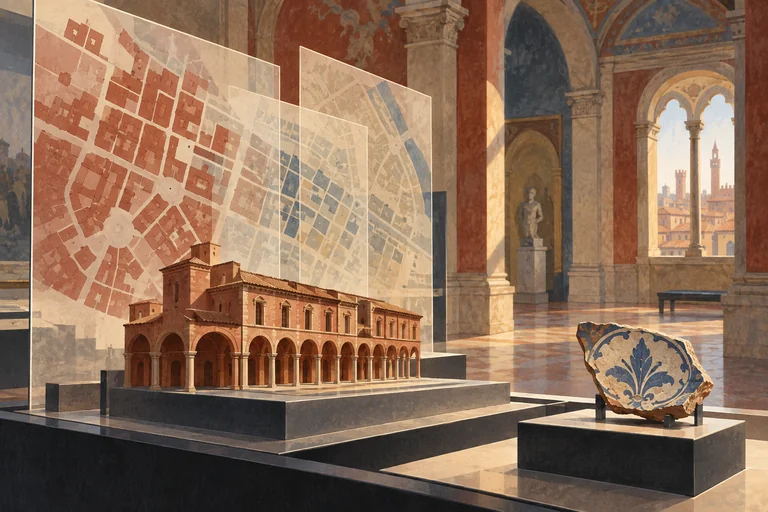
The municipal culture service’s account of the excavation identifies remains associated with Roman Bononia’s civic basilica, medieval houses and the later botanical garden. These are successive uses of a place, not the surviving rooms of one building. That distinction is essential when a compact view makes walls of different dates appear to belong together.
Use any available plan or interpretation to connect a visible feature with its identified period. If a label says that something is a foundation, do not picture the full building as securely known from that fragment alone. A footing can preserve an alignment without telling you the height of a wall, the appearance of its roof or the way every surrounding space was used.
Let a small detail carry the history
The library’s own history discusses the botanical garden associated with Ulisse Aldrovandi and a surviving basin for aquatic plants. This later chapter is a useful reminder that archaeology does not end with Rome. A garden feature, a medieval foundation and an ancient civic structure can each explain a different relationship between the city and this piece of ground.
Choose just one feature that you can identify confidently. Note its shape, material and position, then read what is known about it. This is often more rewarding than trying to assign a date to every exposed stone. Our guide to looking closely at Bologna’s botanical garden offers a present-day companion to the garden story, although the modern visit and the historical remains belong to different settings.
Treat the glass as part of the viewing experience
Reflection, lighting and the angle of your view affect what you can see. Move only within permitted areas and take time to find a clear line of sight. A photograph may flatten differences in depth or combine a reflection with the remains below. Make a quick observation before reaching for your phone: which line is continuous, which is broken, and which feature is closer than you first thought?
For a broader method, the national guide to reading an archaeological site from fragments explains how to keep evidence and reconstruction separate. You can apply the same care to Bologna’s archaeological museum, where objects often provide the starting point rather than an exposed stretch of the city.
Respect the present use of the building
Salaborsa is a working library. Keep conversations considerate, leave circulation routes open and follow staff guidance about photography and group visits. People using a desk or a reading area are not part of the attraction. A brief, attentive stop can fit naturally into a central walk without requiring you to explore every part of the building.
The official excavation information currently states that the below-ground area is not wheelchair accessible. Do not assume that access to the library resolves access to the archaeology. Ask staff about the public-level view and any specific requirements before travelling. Our guide to asking precise step-free access questions can help turn a broad enquiry into a useful answer.
Build a day around one good connection
After your visit, continue through the centre at an unhurried pace or compare the Bologna history experiences for a guided explanation of the wider city. Confirm current excavation hours, visitor limits and any booking requirements directly; library opening and excavation opening need not be identical. The lasting lesson is straightforward: a familiar public place can hold several histories at once, and you can learn to recognize them without forcing every fragment into a single story.
Sources & further reading
Turn a good read into a great day.
Find a highly rated Bolognese experience that brings these stories to life.
Explore related experiences →