Bologna’s San Martino: how can one side chapel shape a church visit?

A side chapel can change the scale of a church visit. You enter expecting a large architectural space, then find a smaller setting that asks you to stand still and look closely. At Bologna’s San Martino, that shift offers a useful way to avoid an exhausting inventory of artists and dates. Begin with the church as a whole, choose one chapel or work that is accessible, and ask how its setting shapes what you notice.
Let the building show more than one period
Bologna Welcome describes the church’s early-fourteenth-century fabric, brick vaults added in the fifteenth century and a facade given Gothic forms in 1879. It also identifies Renaissance patronage in the side chapels. The present building therefore should not be treated as a single medieval moment preserved without change. A pointed arch and an old-looking facade do not automatically share the same date.
The parish’s own history connects San Martino with the Carmelites and records their move here in 1293. That institutional background matters, but it need not become a lecture before you cross the threshold. Start by observing the rhythm of supports, the direction of light and the transition between the main body and smaller spaces. Then use reliable labels or a guide to connect a particular feature with a documented phase.
Our guide to Bologna’s building materials offers another way to look at surfaces without assigning every brick a date. Repairs, cleaning and later rebuilding can all affect appearance. You can say that two areas look different; explaining why they differ requires additional evidence. That modest distinction makes close looking more interesting, because it leaves room for a question instead of rushing to a confident answer.
Choose a chapel and locate the picture
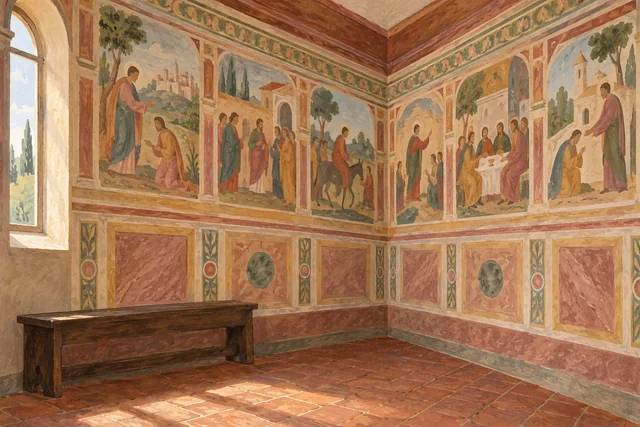
The parish identifies Paolo Uccello’s Adoration of the Child in the Poltroni-Marescotti chapel. If that area is accessible, first locate the work in relation to the chapel rather than immediately isolating it through your camera. Where would a visitor naturally stand? How does the surrounding architecture frame the image? Which details are easy to see, and which require more time or a different viewpoint?
Keep the practical limits in mind. A photograph taken with a long lens may reveal more than you can comfortably see from the permitted visitor position. Do not cross a barrier, lean over furnishings or interrupt someone praying to reproduce a familiar image. The real setting is part of the encounter. Distance, light and quiet can make a short visit feel different from studying a reproduction at home.
Then give yourself a simple looking task. Follow one colour through the composition, compare the direction of two figures’ attention, or notice how the painted space differs from the chapel around it. These are invitations to observe, not claims about the artist’s intention. If an interpretation is not explained by the church’s materials or a reliable study, phrase it as a question. A little uncertainty is more useful than a confident invented symbolism.
Patronage is a route into history
A named chapel invites questions about the people and institutions associated with it. Who commissioned or supported its decoration? How was it used? Which parts of its appearance belong to later changes? You may not find every answer during a casual visit, but noting the chapel’s name gives you a better research starting point than a vague memory of “the picture on the left.”
For comparison within Bologna, the Bentivoglio Chapel at San Giacomo Maggiore and the Santa Cecilia Oratory show how patronage can sharpen a visit’s central question. Keep each place’s history distinct rather than treating every family chapel as an identical statement of power. Different commissions, religious settings and later uses can produce very different relationships between art and space.
Make the visit fit a working church
Bologna Welcome lists San Martino at Via Oberdan 25 and provides ordinary visiting hours with a warning that they may change. Check the parish’s current notices and any service in progress before settling into an art-viewing route. The presence of a historic organ does not imply that a concert or demonstration will be available. Likewise, an open church does not automatically give access to every adjoining room or cloister.
Leave room for a quiet exit and a short walk afterwards. If your trip continues to Verona, San Fermo Maggiore offers a different architectural setting for similar questions about layers and use. For guided options in Bologna, compare the stated stops in our arts and culture collection. One carefully observed chapel can provide more lasting insight than a hurried attempt to identify everything in the church.
Sources & further reading
Turn a good read into a great day.
Find a highly rated Bolognese experience that brings these stories to life.
Explore related experiences →