Bologna in brick: materials that shape the city
Bologna's warm color is easy to notice and surprisingly rewarding to investigate. Look closer than the broad red impression and you find individual bricks, molded terracotta, pale stone, timber and painted plaster doing different jobs. An afternoon spent reading those materials can make an ordinary street feel like an open architectural notebook.
You do not need to identify every building date. Begin with three questions: what carries the weight, what protects the surface, and what was added to make the building expressive? Our introduction to Bologna's porticoes explains the broader urban form; this walk of attention stays with the materials close enough to see.
Distinguish brick from the color red
A reddish wall is not automatically exposed brick. Some surfaces are plastered, others painted, and others reveal the masonry beneath. Look for joints and individual units without touching the wall. Notice changes around corners or doorways, where one treatment meets another. Light can make the same surface look orange at one hour and almost brown at another.
This simple distinction prevents the city from flattening into a single architectural style. A street may contain structures and later repairs from several periods, with surfaces that disguise or reveal those differences. When you cannot tell what you are seeing, keep it as a question. Visual confidence is not a substitute for a building history.
Watch how small units make large forms
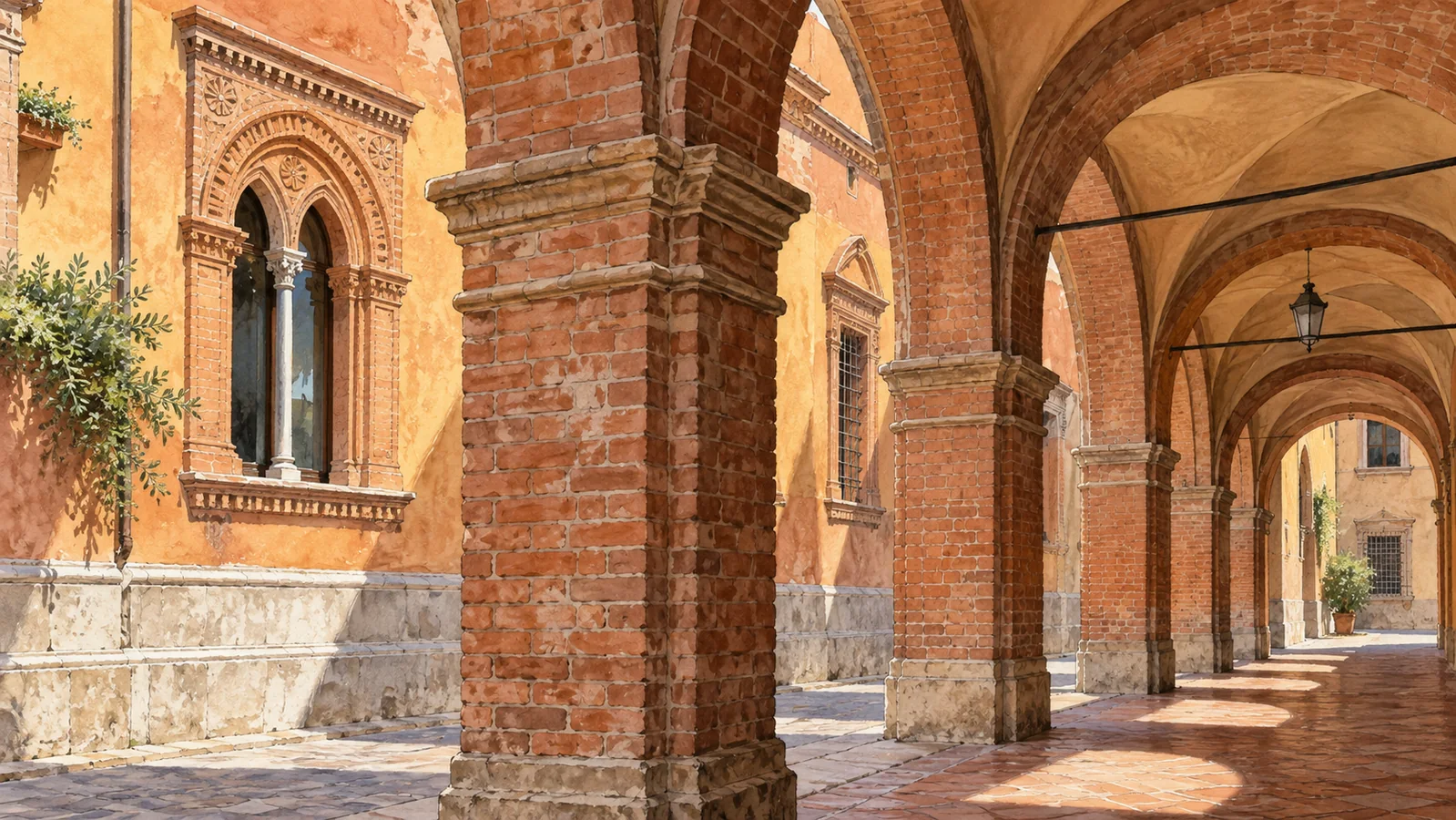
Brick becomes especially interesting around an arch. Follow the curve with your eyes and compare it with the horizontal courses nearby. Then look at the pillar or pier supporting it. The materials are doing structural work, but they are also giving the passage a rhythm. Repetition can turn a covered pavement into a space that feels almost ceremonial.
The municipality's study The Bolognese Portico describes the development from earlier timber structures to brick columns and pillars, including richly worked terracotta details. Use that background to look for differences rather than assigning one age to every portico. Bologna's architectural vocabulary grew through many decisions, not one master design.
Give ornament its own minute
Look around windows and along the edges of arches. A repeated molding can make fired clay behave like a drawn line, guiding your eye across the façade. Compare smooth areas with projecting details that catch shadows. Photograph a whole opening first, then a detail, so that you remember how the ornament belongs to the building.
Keep the pavement usable while you look. Porticoes are working routes for residents, deliveries and everyday journeys, not museum corridors reserved for visitors. A good architectural pause is one that leaves room for everyone else. If a detail is too high or too distant to see safely, enjoy the larger composition and move on.
Let San Petronio complicate the picture
At Piazza Maggiore, the façade of San Petronio offers a particularly clear encounter between materials. Bologna Welcome's official introduction to the basilica explains that the façade remained unfinished and was only partly covered in marble. The contrast is visible evidence that a building's intended finish and its eventual appearance can diverge.
Rather than dismissing an unfinished surface as a missing final step, ask what it lets you see. Compare the lower facing with the masonry above: their color, scale and handling of light. Our San Petronio guide places that observation in the church's civic story. Check current visiting arrangements if you want to continue inside.
Follow a compact route instead of collecting façades
Choose a small part of the center and compare just a few examples. Our walk from Piazza Maggiore toward Santo Stefano provides a useful framework. Let the route remain flexible around worship, local activity and any temporary works. You can learn a great deal from public streets without assuming that every courtyard or doorway is open to visitors.
At each stop, pick one material relationship: brick against stone, timber beneath plaster, or ornament against a plain wall. Record a short note in your own words. The point is not to produce a professional survey, but to build a small visual vocabulary that makes the next street more interesting.
Carry the comparison into another city
If Milan is also on your itinerary, compare Bologna's surfaces with the marble of Milan's Duomo. The contrast encourages useful questions about supply, ambition, maintenance and the effect a building was meant to have. It does not establish a competition between a brick city and a marble one; both contain many materials and many histories.
For a guided introduction, browse our Bologna walking experiences and look for a route whose focus matches your curiosity. Ask a guide about one detail you have already noticed. The best result is not a list of facts to memorize, but a city that becomes easier to read with every block.
Sources & further reading
Turn a good read into a great day.
Find a highly rated Bolognese experience that brings these stories to life.
Explore related experiences →