Bologna’s Villa Ghigi: how do you plan a walk through a hillside landscape?

Bologna’s hills begin close enough to the city to tempt you into treating them as an easy extension of a level street walk. Villa Ghigi rewards a more deliberate plan. Its paths cross a landscape shaped by cultivation, trees and slopes, with the city becoming part of the view rather than the immediate surroundings. Choose your approach and your available energy before deciding how much of the park to cover.
Think of a landscape with several kinds of space
The foundation’s account describes a former agricultural estate whose pattern of fields, fruit trees and wooded areas remains legible. The park opened to the public in 1974. This is a useful alternative to imagining that every green space is either formal garden or untouched nature. Villa Ghigi has a history of work as well as a present life as a public place.
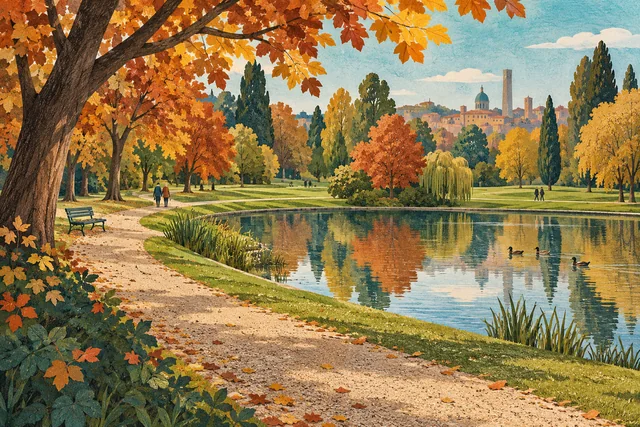
Begin by noticing boundaries: where open grass gives way to trees, where a path follows the edge of a field and where a slope changes your view. These relationships may tell you more than identifying every species. They also offer a manageable subject for a short walk. You can understand one part of the landscape without reaching every named point on a map.
Choose an entrance with the return journey in mind
The official access information distinguishes approaches from the San Mamolo side and from Via Gaibola above. An upper approach and a lower approach are not interchangeable starting points. What feels like an easy descent at the beginning may become the climb you need to complete on the way back. Decide whether you are returning to the same place or leaving by another permitted exit.
Consult the current park map and transport information before setting off. If using public transport, check the actual stop, service and walk to the entrance for your date. Do not assume that the point labelled with a foundation office is the best arrival point for every visitor. Administrative addresses, vehicle access and pedestrian routes serve different purposes.
Let the slope set the pace
Wear shoes suitable for paths and allow extra time after rain, when surfaces can be slippery or muddy. A city outing can become a hillside walk quite quickly. Choose a shorter route if that better suits your party, and turn back while everyone still has comfortable energy for the return. A viewpoint is not worth making the last part of the day miserable.
If mobility, pushchair use or a need for regular seating affects the plan, ask the park team about a specific route and its current condition. Avoid assuming that “public park” means uniformly level or accessible. Describe what you need to know—surface, gradient, steps or distance—rather than asking a question so broad that the answer cannot help you.
Look at fruit trees as part of a managed place
The surviving agricultural character encourages questions about how trees and open ground are cared for. Notice differences in spacing and the way a path relates to planted areas. A row, an isolated tree and a patch of woodland can have very different visual effects. Those observations are a starting point for learning, not enough evidence to assign an age or variety confidently.
Leave fruit, branches and other natural material where they are, and follow the park’s current signs and rules. A public setting does not mean every plant is available for picking. With children, try comparing silhouettes or sketching the shape of a branch from a path. The activity can stay simple and still make the landscape more memorable than a hurried photograph of the skyline.
Keep park access separate from buildings and programmes
The foundation describes the park as open every day, while distinguishing pedestrian access from the operating hours of a vehicle gate. That does not make a late-night walk the sensible choice for an unfamiliar hillside. Plan in daylight, check the weather and any temporary notices, and keep enough margin to leave comfortably before visibility becomes poor.
The villa and foundation premises are not automatically open interiors included in a park walk. Educational programmes also have their own arrangements. If you want a guided activity, consult the current programme and book as required. A school activity described online should not be repackaged as something every visitor can join on arrival.
For other kinds of green-space outing, our Giardini Margherita guide and botanical-garden article offer useful contrasts. San Michele in Bosco raises a different hillside planning question. Compare Bologna walking experiences by their terrain and meeting point.
If Rome is another stop, its Villa Ada article also begins with the practical shape of an outdoor break. At Villa Ghigi, a good walk is not defined by how far you climb. It is one in which the route suits the people walking and the landscape has enough time to become more than a distant view.
Sources & further reading
Turn a good read into a great day.
Find a highly rated Bolognese experience that brings these stories to life.
Explore related experiences →