Why does Bologna have so many porticoes?
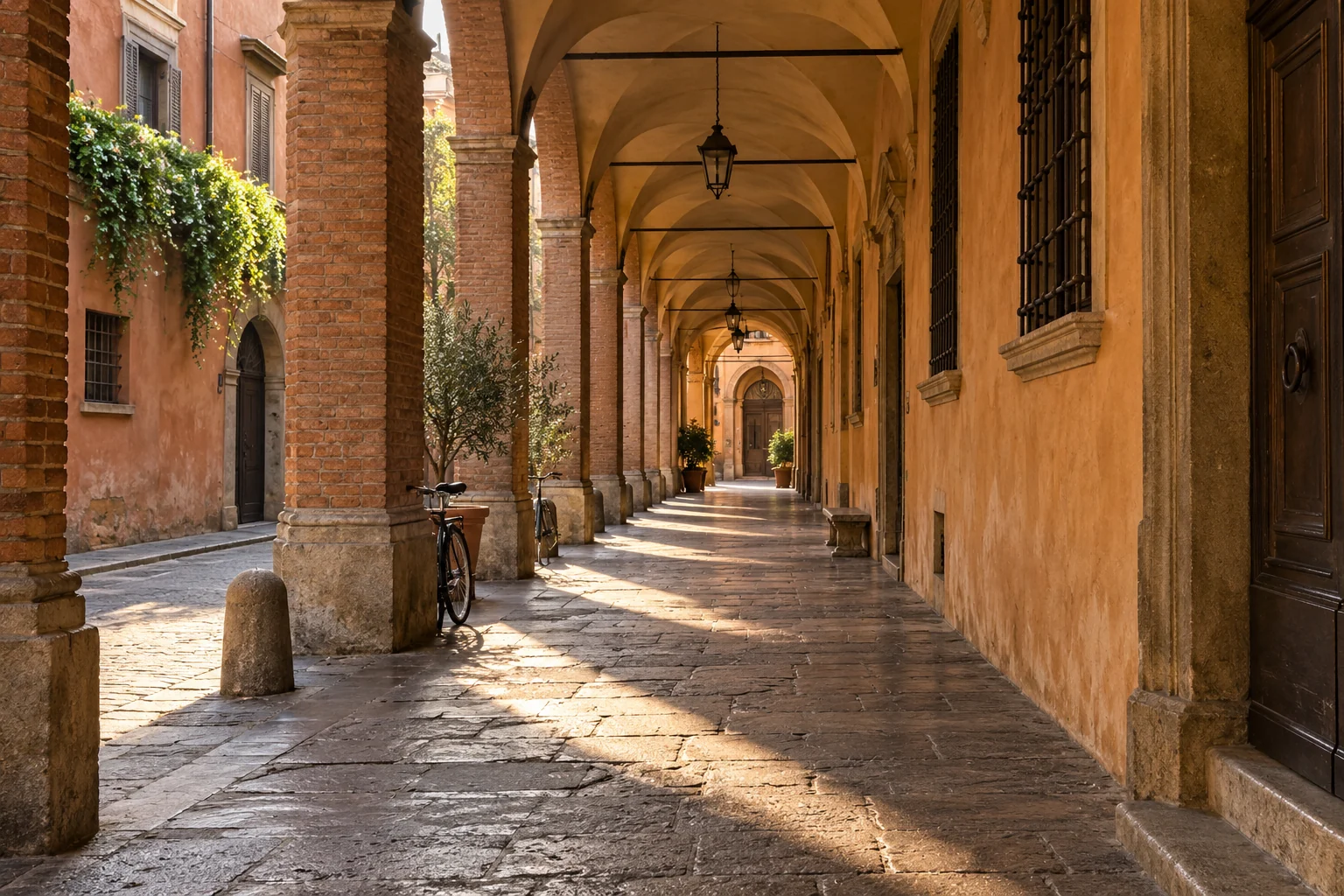
Bologna’s porticoes are more than a handsome answer to rain. They are spaces where private buildings meet public movement: a roof above your head, a doorway beside you, and a continuous invitation to keep walking. Their variety is part of the point. A solemn stone arcade and an irregular timber-supported passage can belong to the same urban story without looking remotely alike.
Look at the relationship between building and street
The basic arrangement is easy to understand. Upper rooms extend above a covered space at ground level, while columns or other supports allow people to pass beneath. That combination makes a façade useful in more than one direction. The building gains space; the street gains a sheltered edge; shops and doorways can engage with movement outside.
It is tempting to explain every portico with a single origin story. Bologna is too layered for that. The official tourism material connects their development with the city’s growth, commerce and expanding university population. For a visitor, the useful lesson is to read them as responses to changing needs, rather than as one coordinated decorative project completed at a particular moment.
Understand what UNESCO actually recognized
The UNESCO World Heritage entry recognizes a serial property made up of selected components. It does not mean that every covered walkway in Bologna is separately inscribed. The distinction matters because the chosen examples show different forms, periods and relationships with the city. Their value lies partly in that diversity, not simply in an impressive total length.
You can appreciate this without carrying an architectural glossary. Ask three simple questions: what supports the roof, what activity happens beside the walkway, and how does the space connect to the next street? Repeating those questions in several places reveals changes that a quick photograph can miss. Our porticoes and landmarks collection is a useful starting point if you want a guide to explain the connections.
Notice materials before memorizing dates
Look for the difference between stone, brick, plaster and timber. Notice whether an arch feels broad or compressed, whether the pavement slopes, and whether the ceiling is plain or elaborately treated. The rhythm can change unexpectedly at a property boundary. Those changes are clues to separate buildings and decisions, not necessarily flaws in an otherwise uniform design.
Stand out of the walking line when you stop to look upward. A portico is still a route to work, a front door and a place for deliveries. Keep bags close to you and avoid blocking a shop while comparing photographs. Good observation and considerate behavior fit together naturally: both involve paying attention to what the space is doing around you.
Choose a walk with contrasting examples
For a compact introduction, combine a central square with a quieter adjoining street. You need not chase a superlative at every turn. A small change in scale may tell you more than another long stretch of similar arches. The Quadrilatero market guide helps connect the covered edge of the civic centre with the more intimate world of shops and food counters.
For a more ambitious outing, the San Luca route raises different questions about distance, slope and devotional travel. Decide whether you want an urban stroll or an extended uphill walk before choosing shoes and scheduling lunch. Covered does not mean flat, effortless or fully sheltered from wind-driven rain. The practical character of each route deserves as much attention as its appearance.
Let the porticoes change how you travel
These spaces reward a slower kind of sightseeing. Pause once to listen, once to examine a surface and once to watch how people pass through an intersection. You may find that the city becomes easier to remember through these small observations than through a list of buildings. The architecture begins to act as a sequence of experiences rather than a backdrop.
If you are comparing cities on a longer trip, the Rome walking-tour collection offers a useful contrast in streets and historical layers. In Bologna, give the covered route itself a starring role. Choose a walk that matches your interests, leave room to ask questions, and let an ordinary stretch between two destinations become a destination of its own.
Sources & further reading
Turn a good read into a great day.
Find a highly rated Bolognese experience that brings these stories to life.
Explore related experiences →