Bologna’s Davia Bargellini Museum: what can useful objects reveal about taste?

A decorative-arts museum asks you to look again at things whose usefulness can make them seem ordinary. A frame holds a picture, a chair supports a body and a piece of metalwork performs a practical job. Yet each can also announce expense, skill, taste or ambition. Bologna’s Davia Bargellini Museum is a rewarding place to explore that overlap between making something work and making it speak.
The official Bologna Welcome introduction identifies two principal strands: the Davia Bargellini picture collection and a broader gathering of applied arts. The phrase “industrial art” in the museum’s name belongs to this history of useful and decorative objects. It should not lead you to expect a factory tour or a gallery devoted only to machinery.
Start with a practical question
Choose one object and ask what it was meant to do. Then look at the decisions that go beyond that basic function. Where has the maker placed ornament? Which surfaces receive the most attention? Does the decoration emphasize the structure, disguise it or compete with it? These questions work even when you cannot identify a period style at first glance.
Follow the edges as well as the most elaborate detail. A corner, joint or transition between materials may tell you more about the object’s construction than its largest flourish. Only examine what is visible from the permitted viewing position. A museum case or barrier is a boundary, and no amount of scholarly enthusiasm makes handling an uninvited object appropriate.
Read the room without inventing a household
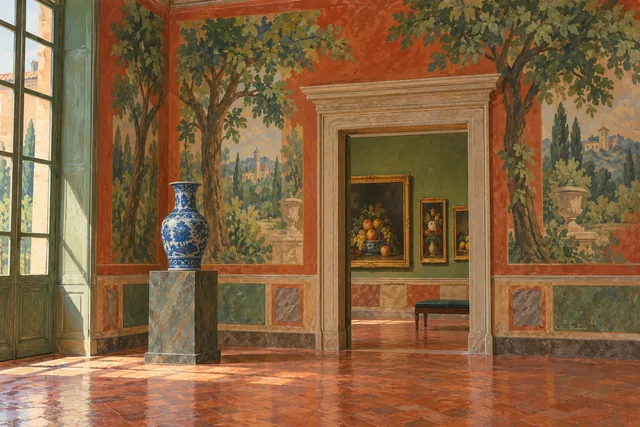
The museum’s displays evoke the atmosphere of an eighteenth-century apartment, but that effect should not be mistaken for an untouched household preserved exactly as its residents left it. Collections assembled through family history, gifts and purchases can bring together objects of different dates and origins. A harmonious room does not prove that everything in it belonged to one person.
Look for the label or collection history that makes the distinction clear. Our guide to Bologna’s Medieval Museum encourages a similar separation between an object’s earlier life and its later place in a collection. The change of setting is itself part of the story, especially when a once-useful thing becomes something we are invited mainly to contemplate.
Compare materials rather than ranking them
A modest-looking ceramic piece may reward as much attention as a richly decorated frame. Try comparing how different materials handle a curved line or a repeated pattern. Wood, metal and clay permit different kinds of decisions. You need not know every technique to notice that one surface appears crisp while another invites softer transitions.
For a wider Bologna connection, our introduction to brick and the city’s materials takes this attention outside. On another part of an Italian journey, Sorrento’s inlaid wood offers a particularly focused encounter with craft. Compare the questions about workmanship without assuming that distant workshops shared the same methods or market.
Notice the difference between an object and its performance
The collection includes a historic marionette theater, a reminder that some objects were made to come alive through use. Looking at a surviving stage or mechanism is different from attending a performance. Ordinary museum access should not be understood as a promise of a demonstration, moving scenery or a scheduled show.
This distinction also appears in Bologna’s Music Museum: an instrument or theatrical object can preserve evidence of performance without reproducing the full event for today’s visitor. Ask what is documented, what survives and what has to be explained through other sources. The gap can be fascinating rather than disappointing.
Give a small museum an unhurried appointment
Check current opening arrangements before heading to Strada Maggiore. The museum occupies the ground floor of a historic palazzo, but “ground floor” is not a complete accessibility description. Confirm the entrance, any steps or ramp arrangements and the facilities you need. Bologna Welcome’s museum page provides institutional context alongside its visitor information; use the museum’s own current notices to confirm arrangements for your date.
Browse the Bologna arts and culture collection if you would like a guided element in the day, checking the actual venues and inclusions. Leave enough time afterward to recall one object precisely. Its material, use and decoration can become three small clues to a much larger history of how people wanted their surroundings to feel.
Sources & further reading
Turn a good read into a great day.
Find a highly rated Bolognese experience that brings these stories to life.
Explore related experiences →