What should you notice in Bologna’s Medieval Museum?

A museum with “medieval” in its name can sound like a test of how many dates you remember. Bologna’s Museo Civico Medievale offers a more inviting possibility: use a few objects to explore how people made authority, learning and belief visible. You do not need to solve the whole Middle Ages before lunch. Start with three materials and see how differently each one carries a story.
The museum occupies Palazzo Ghisilardi on Via Manzoni. The official Bologna Welcome overview describes a collection that includes early medieval objects as well as later works, notably Renaissance and Baroque bronzes. That range matters: the building’s contents should not all be assigned to one period simply because of the museum’s title.
Begin with stone and look at the edges
Choose one carved stone object that you can approach comfortably without blocking the route. Before reading every word of the label, look at its outline. Does the carving seem designed to stand on its own, frame an opening, sit above an observer or attach to something larger? An object’s present museum position may differ from the height and setting for which it was made.
Now inspect an edge, a fold or a repeated pattern. Where does light catch? Where is the surface smooth, and where is it broken or worn? You can observe those differences without deciding immediately what caused them. Consult the label for the object’s date, original location and any recorded restoration. If its former setting is uncertain, that uncertainty is part of its history.
Our guide to Bologna’s building materials makes a useful companion outside the museum. Indoors, the same habit of looking closely can turn a fragment into something more than an isolated old stone.
Ask how an object represents a person
Position, clothing, gesture and scale can all invite an observer to regard a figure in a particular way. Try describing what is visible before naming an emotion or intention. “The figure sits above the smaller forms” is an observation; “everyone feared this person” is a much larger claim that would need evidence beyond the sculpture.
One work highlighted by the official museum overview is the gilded copper statue of Pope Boniface VIII, dated 1301. Let its label guide your reading of the commission and its political setting. Then ask a modest visual question: how do the figure’s material, pose and size affect the way you look at it? That is a useful starting point even if you are new to Bologna’s civic history.
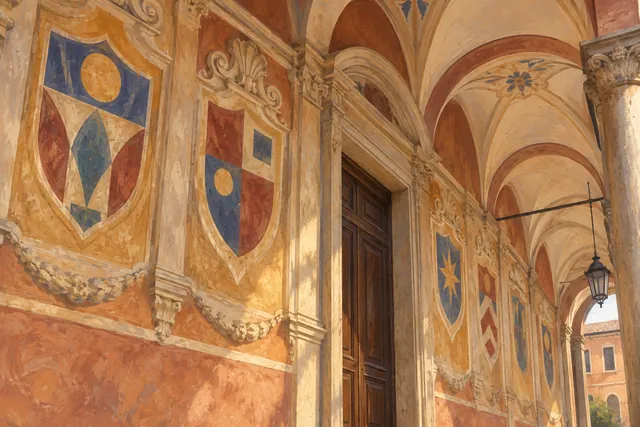
The city’s coats of arms offer another way to explore public identity. Neither an emblem nor a portrait is a neutral summary of a life. Both reward questions about who commissioned them and where they were intended to be seen.
Change scale for metal and manuscripts
A small bronze or a manuscript page asks for a different pace from a large sculptural monument. Pick one detail and stay with it: the turn of a figure, the relationship between decorated border and written area, or the way an object’s surface changes as you move. Follow the display rules and use permitted viewing positions. Ask staff about any permitted tactile access; wanting a closer look alone does not give permission to touch an artwork.
For a manuscript, distinguish the book as a physical object from the text it contains and the decoration added around that text. Read the label for the identification rather than guessing from an unfamiliar script. Not every volume will be open at the same page on every visit, and conservation can affect what is displayed.
Give the visit one connection to the city
You might connect what you have seen to Bologna’s university history, or simply carry the material exercise into a walk under the porticoes. If Florence is also on your itinerary, the Bargello guide through three materials provides a thoughtful comparison without treating the two collections as interchangeable.
Before setting out, check the civic museum’s current visitor information for opening arrangements, temporary closures and access. Our Bologna history experiences can help you find guided context for a wider day. Keep the museum itself manageable: three objects understood a little better will remain with you longer than a hurried attempt to remember every room.
Sources & further reading
Turn a good read into a great day.
Find a highly rated Bolognese experience that brings these stories to life.
Explore related experiences →