Bologna’s Memoriale della Libertà: how do reconstructed scenes shape a history visit?

The Museo Memoriale della Libertà uses reconstructed scenes and sensory interpretation to bring visitors into the subject of wartime Bologna and the Gothic Line. That format can make a historical account immediate, but it also makes preparation useful. Before arriving, understand what is reconstructed, what is an original object and what kind of sound and subject matter your companions will encounter. The aim is an attentive encounter with history, not a test of anyone’s emotional response.
Arrange the visit before travelling
The museum’s official visits page, checked on 4 November 2026, requires appointments. It publishes weekday opening from 10:00 to 18:00, with the last visit at 16:00, and weekend access for groups of at least ten. Treat those details as the basis for an enquiry, not confirmation of an available place. Ask the museum to confirm your date, group size and visiting format.
The venue is at Via Giuseppe Dozza 24. Plan the journey to that address rather than expecting to encounter it during a short walk around Piazza Maggiore. Clarify the duration, language, current charge and whether your booking includes the elements you most want to see. A separate vehicle-park option appears on the official page, so “a museum ticket” is not a sufficiently precise description of every possible visit.
Understand how the narrative is built
The museum’s account of the memorial describes a sequence of scenes involving civilian roundups, the precarious conditions of the winter of 1944, the Battle of Porta Lame and fighting around the Gothic Line. A sequence is an interpretive choice: it selects events and gives them an order through which a visitor moves. Knowing this helps you follow the account without mistaking the entire experience for a surviving wartime environment.
After a scene, ask which details come from identified records or testimony, and which elements help make those sources understandable. A recreated setting may combine evidence to communicate a situation. It should not be treated as a photograph of one complete moment unless the interpretation specifically establishes that. The question strengthens the visit; it does not require dismissing the value of reconstruction.
Prepare for the sensory format
The visits page explicitly describes reproduced battle sounds and scenes alongside original objects such as uniforms and weapons. Discuss that format with children and with anyone who may find loud sound, confined environments or accounts of war difficult. Ask the museum about the actual route, opportunities to pause, alternative interpretation and any elements that can be omitted. Your party’s needs are more useful than a general question about whether the museum is “suitable for everyone.”
Agree that a companion can step back without having to justify their reaction. Some people engage through reading and questions; others need quiet afterward. Our Bologna family-planning guide encourages making those differences part of the itinerary. Avoid placing an emotionally demanding visit immediately before a tight transfer or another activity that leaves no room to decompress.
Look at original objects with precise questions
The vehicle-park description lists military vehicles and railway material, including a locomotive and carriages. Large objects can dominate attention, but size is not the same as explanatory value. Ask what is known about an individual object’s history, how it reached the collection and whether its present appearance reflects restoration. An object of a particular type does not automatically establish that it took part in a particular local event.
For railway material associated with deportation, keep attention on the historical explanation and the people affected. Avoid turning a place of remembrance into a backdrop for playful photographs. Follow the museum’s rules on access and photography, and let its interpretation identify what is documented. The respectful approach is specific rather than theatrical: listen, read carefully and ask a clear question when something is uncertain.
Keep distinct places of memory distinct
Our article on the Museum for the Memory of Ustica addresses a different event and an artistic installation with a different purpose. The Certosa guide concerns a cemetery. They can all encourage reflection, but they should not be compressed into a single generic category of moving experiences.
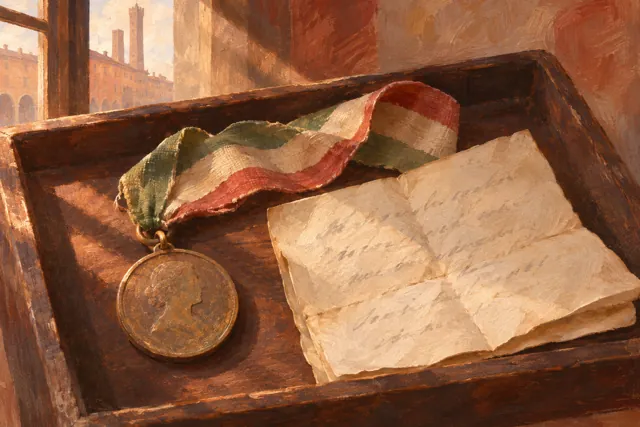
Compare the Bologna history collection by the actual venue and inclusions. A wider northern-Italy journey can also draw on Turin’s history collection, with each booking checked separately. The artwork accompanying this article is a symbolic arrangement of everyday belongings, not a museum scene. Leave the Memoriale with one historical question to pursue and a clear distinction between the evidence you encountered and the methods used to present it.
Sources & further reading
Turn a good read into a great day.
Find a highly rated Bolognese experience that brings these stories to life.
Explore related experiences →