Bologna’s Santa Maria dei Servi: how does a portico prepare you for a church?

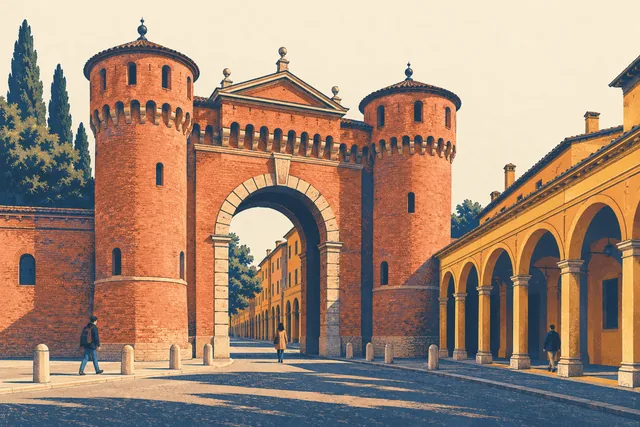
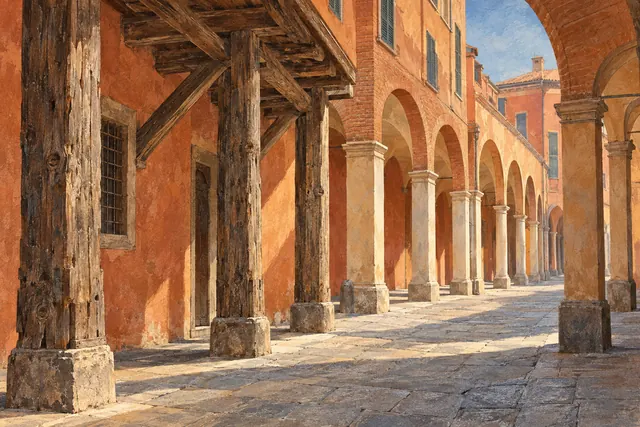
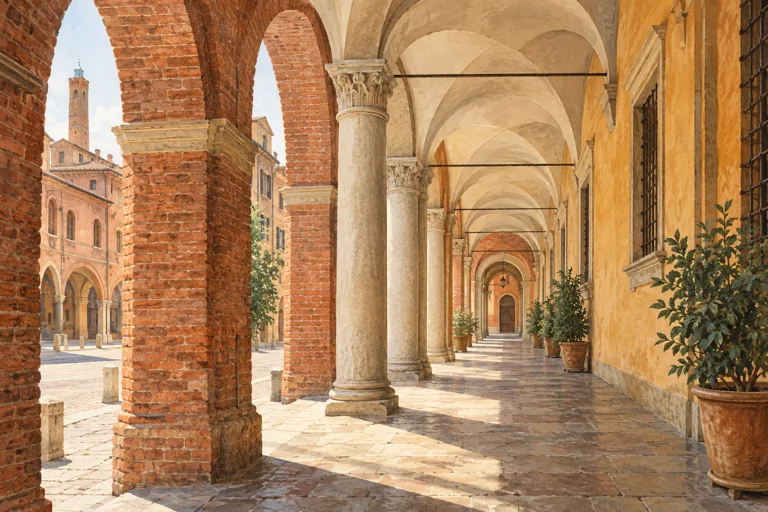
A portico can do more than shelter a pavement. At Santa Maria dei Servi in Bologna, the covered edges of the space in front of the church change the rhythm of an approach. You move between street, enclosure and entrance, with columns repeatedly framing what lies beyond them. Before stepping inside, spend a little time on that transition. The architecture has already begun the visit.
Notice how the courtyard relates to the street
The church stands on Strada Maggiore, and its quadriportico is part of Bologna’s broader history of covered urban space. The municipal portico account records a late-fourteenth-century concession of public land to the Servi di Maria for construction. This gives a useful starting point: the portico was negotiated within a city, rather than placed on an empty architectural drawing.
Watch how people use the edges and crossings today, while keeping the route clear yourself. A visitor pausing to look, someone passing through and someone approaching worship may occupy the same space for different reasons. That present-day observation does not prove an unchanged medieval pattern, but it helps you understand why the relationship between building and circulation deserves attention.
Do not compress the structure into one building date
The portico grew and changed over several centuries. Bologna Welcome describes extensions running across several centuries, into the nineteenth century. A single date attached to the earliest construction cannot explain everything now visible. Treat a historical label as the beginning of a sequence rather than the birthday of every column.
Try looking for differences in how one stretch meets another. You need not be able to date masonry by eye to ask whether a junction is straightforward or awkward. Where the evidence is unclear, leave the question open. An architectural walk is more interesting when it encourages careful observation than when it assigns confident dates to every irregularity.
Let repetition guide your eye
Stand where you are not blocking a doorway and look along a row of supports. Repetition creates a rhythm, while the changing angle of view makes the spaces between columns appear to narrow. Then turn toward the open centre. The contrast between covered edge and open sky can make the courtyard feel different from the street even before you enter the church.
This is a suggested looking exercise, not a claim that the whole complex was designed to produce one precisely documented emotional response. Light and weather change the effect. A grey morning may emphasise outlines; stronger sun may make shadows more prominent. Neither condition is the wrong one for understanding how a portico organises space.
Give the church a separate moment of attention
Bologna Welcome identifies Santa Maria dei Servi as a Gothic church with a significant collection of art, including a Madonna by Cimabue. Once inside, begin with the room before choosing a single work. Notice the direction of the nave, the relationship of side spaces to the main route and the place where your attention naturally settles.
Read current labels rather than relying on an old photograph to determine exactly what is on view. A church is also a place of worship, with activities that may limit tourist movement. Keep conversations quiet, follow photography rules and leave a service undisturbed. The distinction is practical as well as courteous: an open door is not a promise that every area is available for sightseeing.
Plan around the actual visiting window
As checked on 26 October 2026, the official destination page lists Monday opening from 08:30 to noon, and Tuesday to Sunday from 08:30 to noon and 16:00 to 19:00. It warns that visits can be limited during religious functions. Check the current notice before travelling specifically for the interior, and allow time before closing rather than treating the last minute as an arrival target.
The bell tower is not ordinarily open to visitors. Do not interpret a mention of the tower in the building’s history as an included climb. Likewise, a concert, special opening or seasonal market has its own dates and conditions. Enjoy the ordinary architectural setting without promising an event that may not be taking place.
Our guide to Bologna’s UNESCO porticoes explains why the broader designation needs careful reading. San Petronio and San Giacomo Maggiore offer distinct church visits, each with separate access questions. Compare portico and landmark experiences by the route and interior entries actually listed.
For an urban comparison beyond Bologna, Rome’s Portico d’Ottavia neighbourhood article considers another relationship between inherited architecture and a living city. At the Servi, leave with one clear observation about how a covered edge changes your movement toward an open space. That small piece of understanding can transform the next portico you walk beneath.
Sources & further reading
Turn a good read into a great day.
Find a highly rated Bolognese experience that brings these stories to life.
Explore related experiences →