Bologna’s timber and masonry porticoes: how can you compare them?

Bologna’s porticoes are easy to experience as one continuous shelter. Slow down and the continuity begins to reveal variety: a tall timber post, a bracket, a brick arch, a plastered support that changes the rhythm of the pavement. Comparing materials gives a familiar walk a new focus. You do not need an architectural glossary or a long route. Two or three carefully observed examples can teach more than an afternoon spent counting arches.
Start with structure rather than a date
At any portico, begin by asking what appears to support what. Follow a vertical element upward with your eyes. Does it meet a horizontal beam, an arch or a branching bracket? Look at how the junction is expressed and whether it is easy to see from the pavement. You are observing visible form, not conducting a structural survey. Avoid touching, climbing or judging a building’s safety from surface appearance.
Material is a clue rather than a complete chronology. Timber does not give you an exact medieval date, and masonry does not guarantee that every part was built at once. Repair, replacement and altered finishes complicate the picture. Our introduction to why Bologna has so many porticoes provides the broader urban story; this walk concentrates on how individual examples look and feel.
Use timber examples to sharpen your eye
Bologna Welcome’s overview identifies Casa Isolani on Strada Maggiore and examples in Via Marsala among the city’s surviving wooden porticoes. Its separate Palazzo Grassi description draws attention to the characteristic shape of the timber supports. Use those named examples to begin a comparison rather than treating any wooden-looking feature as interchangeable.
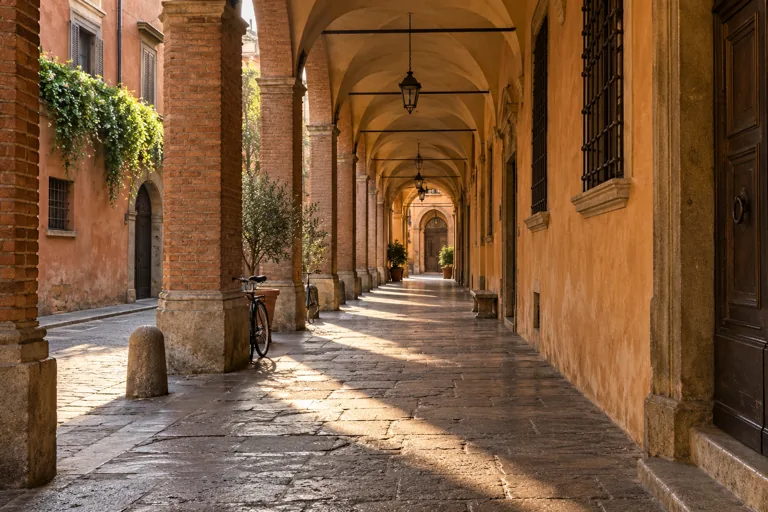
Notice the relationship between the post and the building above. Then examine the base, the upper connection and the space left for walking. You may find that a feature looks surprisingly slender from one angle and substantial from another. Record what you see in ordinary language: tall, branching, recessed, rough or smooth. A photograph taken from a safe position can help you compare later, but keep entrances and the walking line clear.
Compare an arcade without turning the walk into a race
The municipality’s account of the Portico dei Servi describes the grant of public space to the Servite community in 1392 and places the portico among early masonry examples. For a Strada Maggiore outing, it offers a different architectural subject from Casa Isolani. Check the current walking route and any works before setting off; this is a comparison idea, not a promise of an uninterrupted or step-free connection.
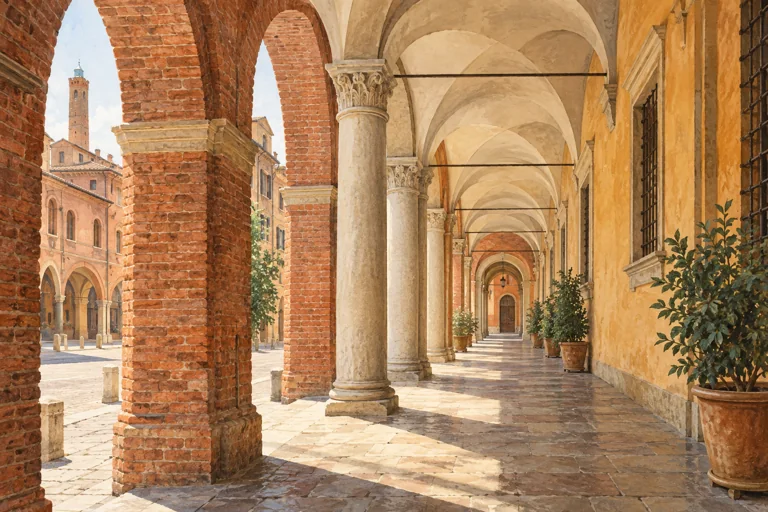
Look at repetition. How much of the view is framed by one opening, and how does that frame change as you move? An arch can make the path seem like a sequence of rooms, while another kind of support may leave a more open impression. These are personal observations you can test with a companion. Your reactions do not have to agree for the exercise to be useful.
Be cautious about what a surface tells you
Paint, plaster and facing materials can disguise what lies beneath. The city’s building-history map, for example, describes plastered brick supports that imitate stone at Palazzo Lupari Isolani. That is a helpful warning against assigning material solely by color. Use the official entry for the exact building when you want more than a visual impression, and distinguish a supported description from your own guess.
Our article on Bologna’s brick develops this attention to surfaces. You can also compare what a portico offers as a public passage with why particular stretches matter to heritage recognition in our UNESCO porticoes guide. Not every feature needs the same explanation, and the city is more interesting when its differences remain visible.
Build a short route around your group
Choose either a small cluster along Strada Maggiore or a separate look around Via Marsala rather than assuming everyone wants a cross-city architecture march. Consider walking distance, pavement, weather and places to pause. A roof overhead does not eliminate every crossing, step or busy section. Leave room to change the plan if a street is crowded or works interrupt your intended view.
Compare Bologna experiences if a guided explanation would make these details more rewarding, checking that the actual route covers your interests. If Florence is another stop, our slow Oltrarno walk carries the same patient approach into different streets. Bring home one comparison you can explain clearly: how two sets of supports shaped the space around you. That is a more lasting souvenir than a hurried catalogue of everything passed.
Sources & further reading
Turn a good read into a great day.
Find a highly rated Bolognese experience that brings these stories to life.
Explore related experiences →