Bologna’s Porta Saragozza: why does a medieval gateway look so much newer?

Porta Saragozza can tempt you into a quick conclusion: brick, towers and an arch must mean a medieval gateway preserved just as it was. The more interesting story begins when you resist that shortcut. The gate has medieval origins, but its conspicuous present appearance owes much to nineteenth-century rebuilding. It is a useful place to ask how a city represents its past while continuing to use the streets that pass through it.
Separate the age of the place from the age of its appearance
The official Bologna tourism account places the gate in the city’s thirteenth-century wall circuit and records a drawbridge in the following century. It also dates the major rebuilding that produced its current form to 1857–1859, associating the work with Enrico Brunetti Rodati and Giuseppe Mengoni. Those statements are compatible: an old urban threshold can acquire a substantially newer architectural expression.
The practical lesson extends beyond this one monument. A traditional material is not a reliable date stamp. Neither is a crenellated outline or a rounded tower. Before deciding that a surface offers direct evidence of medieval building practice, ask whether restoration or redesign has intervened. You do not need to distrust the monument; you simply need to let its nineteenth-century chapter be visible in your understanding.
Look at the gate as a route-making object
Find a safe place to stand, away from traffic and without obstructing the pavement. Look at the passage through the gate, then at the routes approaching it. A gateway connects spaces as well as separating them. Its meaning depends partly on the movement it directs: people arriving, people leaving, processions, everyday journeys and the modern circulation that now surrounds it.
Try a small observation exercise. First describe only what you can see: the relation between the central opening and the flanking forms, the use of brick, the scale of a pedestrian beside the structure. Then add the historical information from the official account. Keeping those two stages separate helps prevent an attractive architectural feature from becoming evidence for a story you have merely assumed.
The portico gives the gate another context
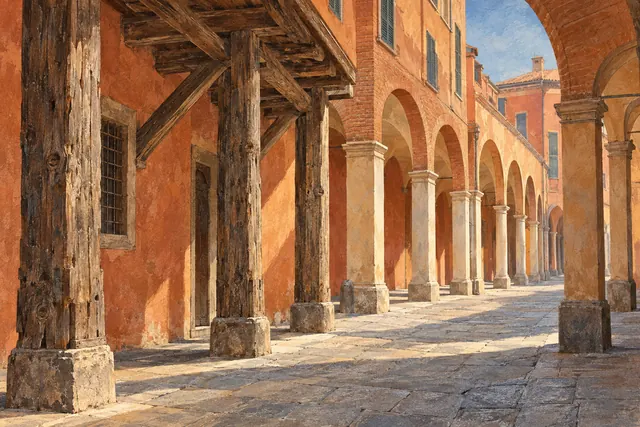
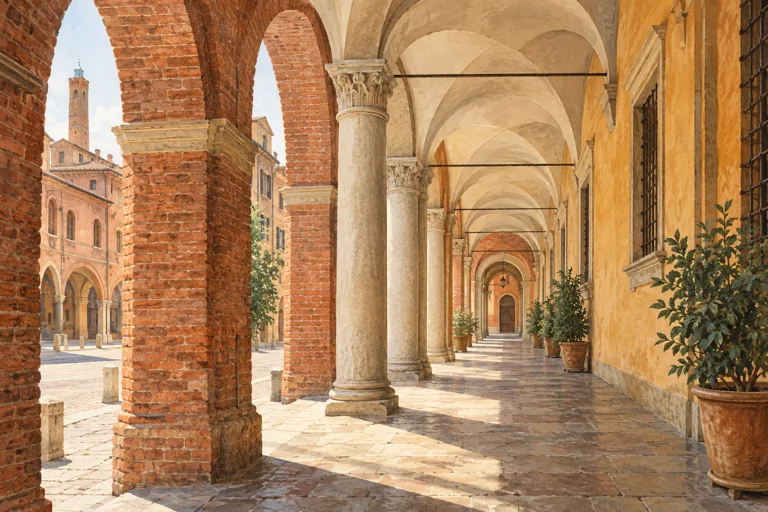
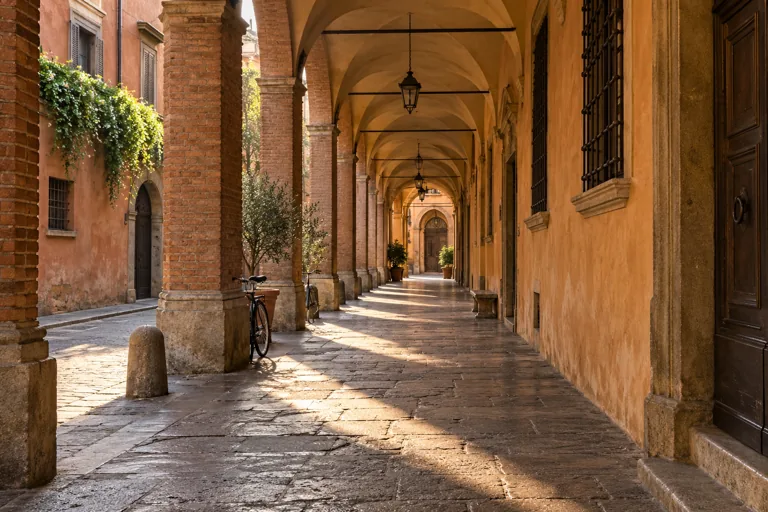
Porta Saragozza is closely associated with the route towards San Luca. The construction of the long portico in the seventeenth century gave this urban threshold an additional processional significance. For a visitor, that relationship is easier to understand by noticing the continuity of the route than by treating the gate as an isolated object to photograph and immediately leave.
That does not mean you must walk all the way to the sanctuary to make the stop worthwhile. Our guide to deciding whether the San Luca walk suits your trip considers the larger outing. A short section can still reveal how repeated arches organise movement and shelter. Choose the length according to your energy, available time and return plan, rather than allowing the monument to commit you to a hike you have not planned.
A nineteenth-century choice is history too
It is easy to value the gate only to the extent that it preserves something older. But rebuilding is itself a historical act. It shows that the gateway continued to matter enough to be given a new public form. The question “Why did later people want this entrance to look this way?” can be more productive than searching for an untouched medieval surface everywhere you look.
Do not answer that question by inventing a motive for an architect or treating a revival style as a transparent political statement. The official chronology gives you a firm starting point; further interpretation needs further evidence. For an ordinary walk, it is enough to recognise that different periods can be present in the same landmark, and that the newest-looking intervention may already be well over a century old.
Keep the visit practical and proportionate
An exterior stop and an interior museum visit are different plans. The official listing identifies the gate’s association with the Museum of the Blessed Virgin of San Luca, but that alone does not confirm that the museum is open when you pass. Check its own current arrangements if entry is important to you. Avoid describing a gateway walk as a guaranteed visit to the rooms above it.
Our guides to Bologna’s porticoes and the city’s brick architecture provide two complementary ways to continue looking. For a guided route, compare the actual meeting point and named stops in our Bologna experience collection; do not assume every city walk reaches this part of town.
Rome’s Museo delle Mura offers another city-gate comparison, with a very different chronology and visitor setting. At Porta Saragozza, the rewarding discovery is the double perspective: an old threshold still shaping a route, and a later city choosing how that threshold should appear.
Sources & further reading
Turn a good read into a great day.
Find a highly rated Bolognese experience that brings these stories to life.
Explore related experiences →