Santo Stefano: how to enjoy Bologna’s layered church complex
Santo Stefano rewards the kind of attention that a busy itinerary tends to squeeze out. Instead of one grand interior that announces itself immediately, the complex invites you to notice transitions: an opening, a change in light, a shift of material, a room with different proportions. You may remember the experience as a sequence rather than a single view. That is a good reason to arrive with time to look.
Begin with the idea of a complex
The official Bologna visitor guide presents Santo Stefano as a group of religious buildings developed across different periods. Its familiar association with seven churches is a useful introduction, but a visit need not become a counting exercise. The more interesting question is how different spaces fit together and how later users adapted what they inherited.
Do not expect every part to offer a simple, uncontested origin story. Historic religious sites can combine documentary evidence, building archaeology and devotional traditions. A good guide distinguishes between them. When an explanation involves a tradition or interpretation, hearing that distinction makes the story more interesting, not less. The site is rich enough without requiring every attractive anecdote to be treated as established fact.
Use the square as a pause before entering
Give the approach its own moment. Find a position that leaves routes and entrances clear, then look at how the surrounding buildings frame the space. Squares are useful places to change pace: you can check the next part of the route, put away a drink and decide whether your group is ready for a quieter visit. Preparation outside makes considerate behavior inside much easier.
Our first-day Bologna plan leaves room for Santo Stefano as one possible afternoon direction. That is a choice rather than an obligation. If you have just completed a long food tour, you may enjoy a brief exterior stop more than an interior visit made while tired. Attention is a resource; spend it where your curiosity is strongest.
Notice thresholds, materials and scale
Where access is permitted, look at the points where one space becomes another. Are you stepping into brighter light or deeper shade? Does the ceiling feel closer? Are the supports uniform or varied? These observations create a personal map of the visit without requiring you to memorize the names of every architectural element. They also give a guide a useful starting point for explanation.
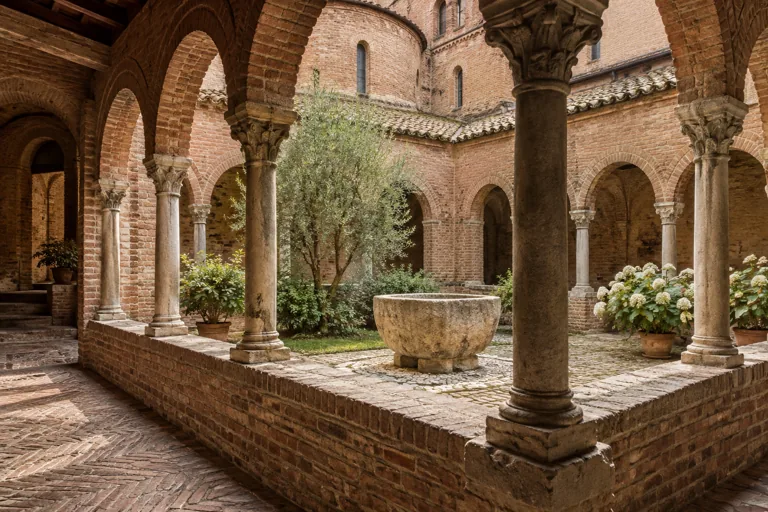
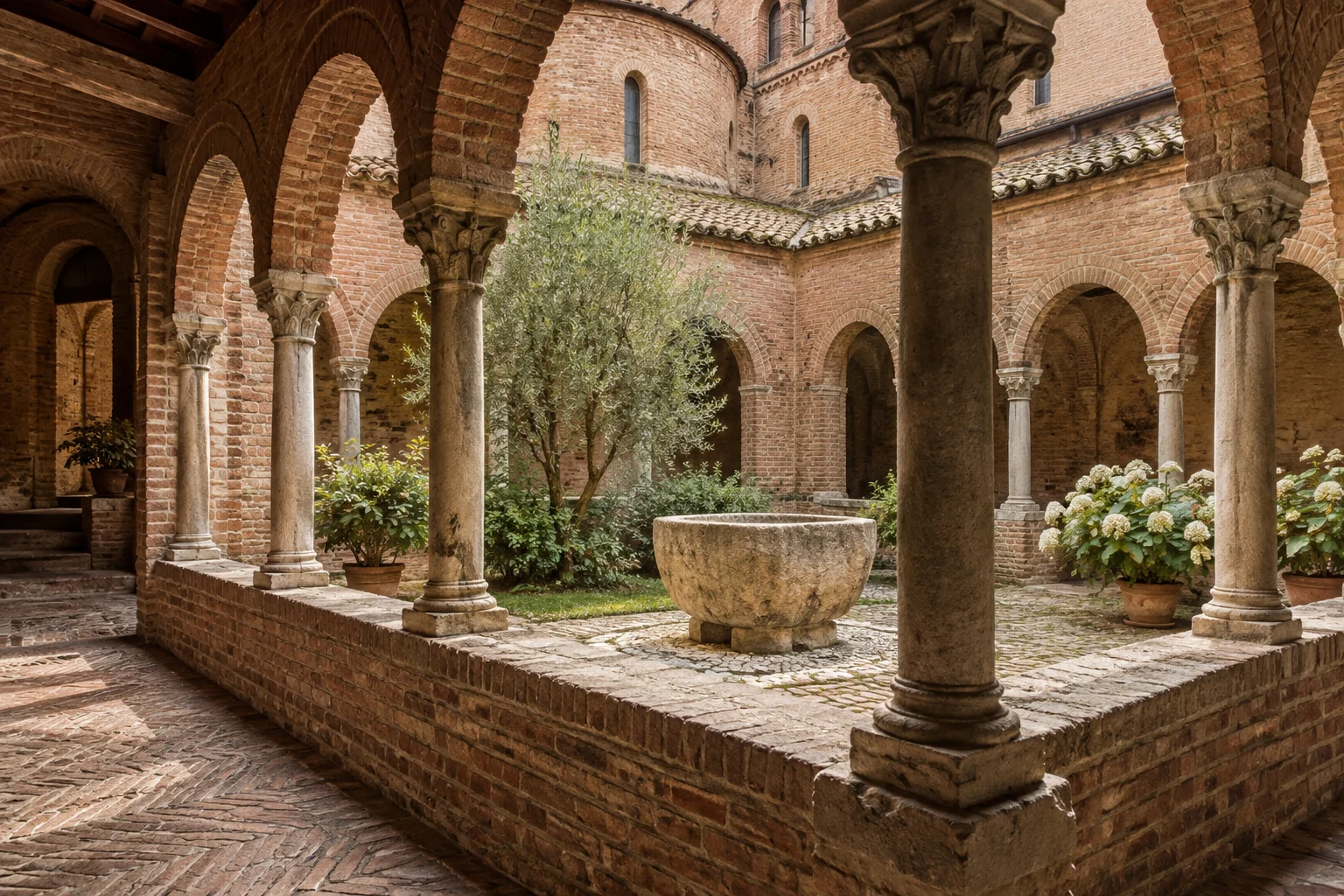
The official description identifies a cloister among the complex’s features. A cloister is worth experiencing as a space of movement and enclosure, not merely as a frame for a photograph. Notice the rhythm of its openings, the relationship between covered and open areas, and the way sound changes. Avoid assuming that every visible doorway leads to a publicly accessible room.
Let the religious setting shape your visit
Santo Stefano remains a place of worship. Services and religious activity can affect access, and visitor behavior should respond to the people using the site. Follow current signs, keep voices low and put photography aside when it would interrupt prayer or a service. An unavailable room is a reason to adjust your visit, not to negotiate with staff at a doorway.
If steps, seating or sensory conditions affect your group, ask about the specific route before arriving. A general description of a historic complex does not establish that every section has the same access. Our walking-tour collection can help you compare guided routes, but the operator should confirm the actual itinerary and any access arrangements that matter to you.
Pair it with a contrasting Bologna experience
San Petronio offers an interesting comparison in scale and relationship to civic space. Read our San Petronio guide if you want to connect the two thoughtfully, perhaps on different days. Another good pairing is a slow walk beneath nearby porticoes. Our porticoes introduction suggests simple things to notice as covered streets return you to the everyday city.
There is no prize for seeing every available corner. Choose one detail you would like to remember and give it an extra minute. A worn surface, a quiet courtyard or a surprising change of proportion can hold a place in your memory more firmly than a list of dates. Santo Stefano is especially good at reminding visitors that understanding a city sometimes begins by slowing down.
Sources & further reading
Turn a good read into a great day.
Find a highly rated Bolognese experience that brings these stories to life.
Explore related experiences →